
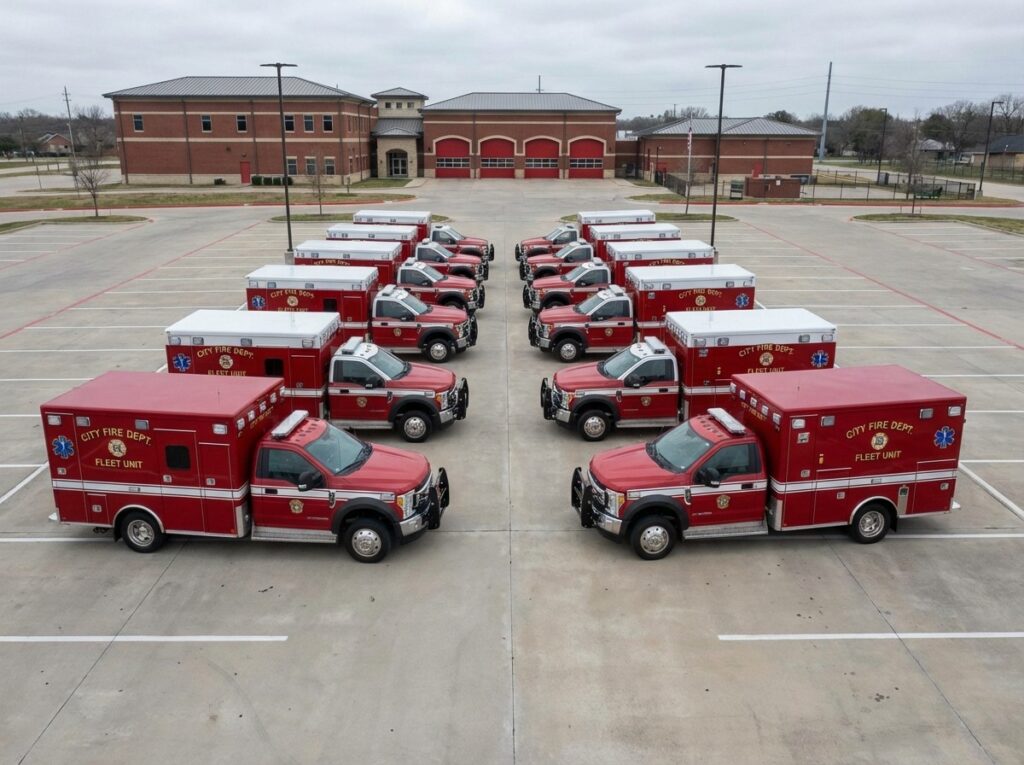
Project Spotlight: City Fire Department Fleet Revitalization
TRES recently completed a landmark fleet revitalization project for the City Fire Department, successfully delivering 12 fully updated units in record time.
This project serves as a definitive case study for municipal agencies facing the dual pressures of aging apparatus and tightening fiscal budgets. By leveraging a strategic Fire Department EMS Remount program, the City Fire Department extended the lifecycle of their critical assets by an estimated seven to ten years while retaining the custom module configurations their paramedics rely on.
The Challenge: Aging Chassis and Budget Constraints
The City Fire Department faced a critical operational bottleneck. Their existing fleet of Type I ambulances possessed high-quality, custom-built patient modules that were still structurally sound.
However, the underlying chassis were approaching high-mileage thresholds, leading to increased maintenance costs and unacceptable downtime.
The department required a solution that would:
- Restore vehicle reliability immediately.
- Preserve the department’s custom module layout.
- Adhere to strict municipal budget caps that precluded purchasing 12 brand-new vehicles.
- Minimize the time units were out of service.
The Solution: A Strategic Fire Department EMS Remount
TRES implemented a high-velocity production schedule to address the City’s needs. The core of this solution was separating the existing patient modules from the tired chassis and mounting them onto factory-fresh, heavy-duty chassis platforms.
This process allows departments to capitalize on the initial investment made in the patient compartment box while eliminating the mechanical liabilities of an old engine and drivetrain.
Key Technical Upgrades
The revitalization went beyond a simple chassis swap. TRES technicians performed comprehensive upgrades to ensure the units met modern safety and performance standards:
- Chassis Integration: The modules were mated to new Ford F-series chassis, featuring updated suspension systems for improved ride quality and patient comfort.
- Electrical Modernization: Legacy wiring was replaced with state-of-the-art multiplex electrical systems, improving diagnostic capabilities and system reliability.
- HVAC Overhaul: The climate control systems were upgraded to high-capacity units capable of maintaining compliant temperatures in extreme weather conditions.
- Corrosion Mitigation: Modules underwent rigorous sanding, corrosion repair, and the application of high-grade automotive paint to match the City’s new fleet graphics standards.
Operational Efficiency: Delivering in Record Time
One of the defining metrics of this project was the turnaround time. In the emergency services industry, fleet downtime translates directly to reduced community coverage.
TRES utilized a parallel production workflow to accelerate the delivery schedule. By pre-staging the new chassis and preparing the refurbishment components before the old units arrived at the facility, TRES minimized the “out-of-service” window for each ambulance.
This streamlined approach allowed the City Fire Department to rotate vehicles through the remount process without disrupting daily emergency response operations.
Financial Impact and ROI
For municipal procurement officers and Fleet Managers, the “Total Cost of Ownership” (TCO) is the ultimate decision factor.
This Fire Department EMS Remount project delivered substantial savings compared to purchasing new:
- Capital Savings: The department saved approximately 40% to 50% per unit compared to the cost of buying new custom Type I ambulances.
- Extended Lifespan: The remounted units are projected to serve the city for another full lifecycle rotation.
- Reduced Maintenance: The warranty coverage on the new chassis significantly lowers the anticipated maintenance budget for the next three years.
Compliance and Safety Standards
Revitalizing a fleet is not just about aesthetics; it is about compliance. TRES ensured that all 12 units met current safety benchmarks.
The engineering team verified that the remounted vehicles adhered to relevant industry standards, including:
- KKK-A-1822F: Federal specifications for the Star of Life ambulance.
- FMVSS: Federal Motor Vehicle Safety Standards regarding lighting, braking, and restraint systems.
- Payload Capacity: Weight distribution analysis was conducted to ensure the new chassis could safely handle the module, crew, and equipment load.
Conclusion
The City Fire Department project demonstrates that a well-executed remount strategy is superior to a replacement-only model for many municipalities.
By choosing TRES, the City Fire Department secured a reliable, modern fleet for a fraction of the cost of new vehicles, all while minimizing operational disruption.
Ready to evaluate your fleet options? Contact TRES today for a fleet analysis and remount feasibility study.