
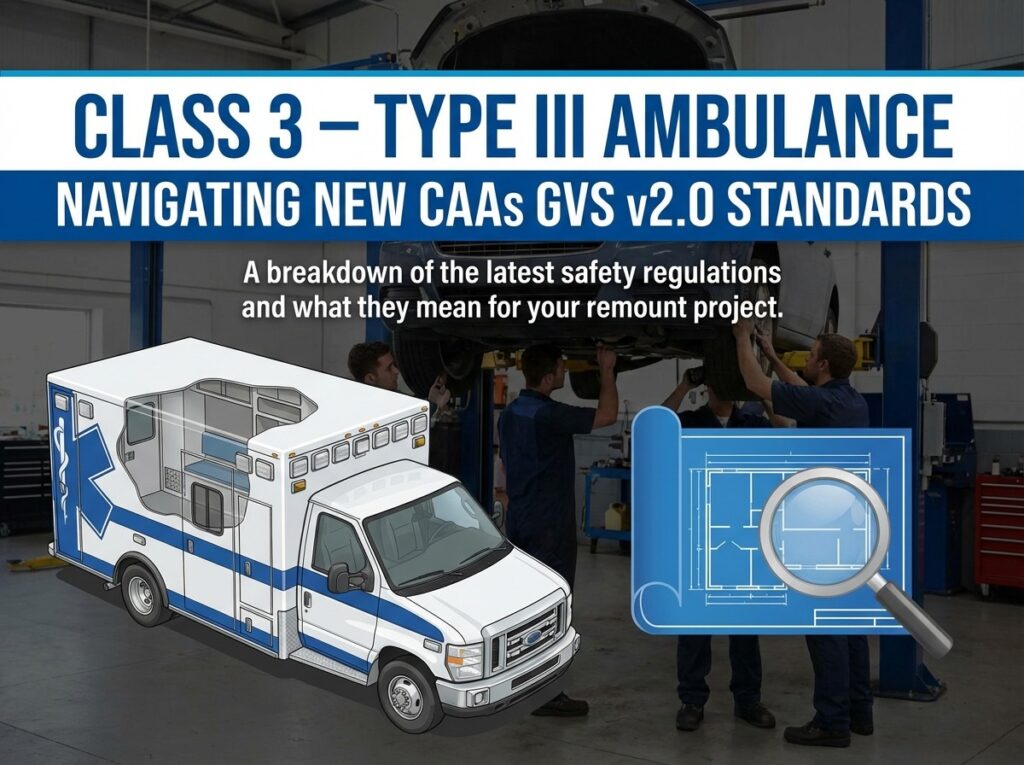
Navigating New CAAS GVS v2.0 Standards for Your TRES Remount
The shift toward the CAAS GVS v2.0 Standards represents one of the most significant leaps in ambulance safety and design in the last decade. For fleet managers and EMS directors, the pressing question isn’t just about what these rules say, but how they apply to existing assets.
Here is the bottom line: You don’t need to purchase a brand-new vehicle to achieve compliance. A high-quality remount project, when engineered correctly, can meet the rigorous safety and performance benchmarks set by the Ground Vehicle Standard (GVS) v2.0. This allows your department to maintain the highest safety levels while preserving capital budget.
What Are the CAAS GVS v2.0 Standards?
The Commission on Accreditation of Ambulance Services (CAAS) established the Ground Vehicle Standard (GVS) to create a consensus-based standard for ambulance design. Unlike the federal KKK-A-1822F specification, which was originally a purchasing spec for the GSA, the GVS v2.0 is designed by the industry, for the industry.
It brings together manufacturers, providers, and safety experts to define what a modern emergency vehicle should look like.
The v2.0 update specifically addresses the evolving needs of EMS providers. It moves beyond simple dimensions and focuses heavily on:
- Crashworthiness: Ensuring the patient compartment remains intact during a collision.
- Payload Capacity: Preventing overweight vehicles that compromise braking and handling.
- Component Safety: Securing equipment and seating to prevent projectiles during an accident.
For a TRES remount project, this means we aren’t just swapping a box onto a new chassis. We’re upgrading the module to meet modern expectations.
Does a Remount Have to Be GVS Compliant?
Technically, compliance requirements depend on your state’s specific legislation and your agency’s internal risk management policies. However, adopting CAAS GVS v2.0 Standards during a remount is a best practice that limits liability and protects your crew.
When you remount a module, you are effectively manufacturing a new vehicle in the eyes of many regulatory bodies.
If you ignore these updated standards, you risk operating a vehicle that falls short of current industry safety benchmarks. In the event of an accident, a non-compliant vehicle can become a massive liability issue for your municipality or private service.
Key Technical Changes Affecting Remounts
Understanding the v2.0 standard requires looking at the specific components we address during the remount process. It’s not just about a fresh coat of paint and new flooring.
1. Structural Integrity and Mounting
The interface between the new chassis and the existing module is critical. GVS v2.0 places a heavy emphasis on body mounting.
- We inspect the module’s sub-frame for fatigue.
- We utilize upgraded mounting hardware that meets the shear and tension requirements of the new standard.
- OEM chassis guidelines are strictly followed to ensure the “box” and the “truck” move together safely.
2. Payload and Weight Management
One of the biggest issues with older ambulances is that they are often overweight. As equipment loads increased over the years, the available payload shrank.
- GVS v2.0 mandates strict payload calculations.
- During a TRES remount, we weigh the demounted module.
- We select a chassis with the appropriate Gross Vehicle Weight Rating (GVWR) to handle the module plus the required payload for crew, patients, and gear.
3. Seating and Occupant Safety
The days of the side-facing bench seat with a simple lap belt are numbered. While existing layouts can sometimes be grandfathered depending on local laws, moving toward GVS compliance often means upgrading seating.
- We install 4-point or 6-point harnesses.
- We reinforce the backing plates in the walls and floor to ensure seat mounts can withstand the g-forces defined in the standard.
The TRES Certification Process
How do you prove your remounted ambulance is safe? It comes down to documentation and certification.
When TRES completes a project under these specifications, we provide a final stage manufacturer label. This certifies that the completed vehicle—chassis plus remounted module—conforms to the applicable safety standards.
We verify compliance through:
- Electrical Load Testing: Ensuring the alternator and electrical system can handle the load without overheating.
- Weight Verification: Providing a final weight ticket to prove payload capacity.
- System Testing: Checking oxygen systems, suction, and HVAC against performance metrics.
Why Remounting is the Smarter Financial Move
Budget constraints are a reality for almost every Fire Chief and EMS Director. New ambulances that fully comply with CAAS GVS v2.0 Standards have seen price spikes due to chassis shortages and rising material costs.
Remounting offers a solution that bridges the gap between safety and solvency.
By choosing a remount, you save the cost of manufacturing the module shell and cabinetry. Those savings—often 25% to 40% compared to buying new—can be reinvested into the upgrades required for GVS compliance.
You get a vehicle that looks new, drives new, and meets the safety standards, all without draining your capital reserve.
Preparing Your Fleet for the Future
If you have a fleet of Type I or Type III ambulances approaching the end of their chassis life, now is the time to evaluate them for GVS v2.0 readiness.
Don’t wait until the engine blows to make a plan.
Actionable Steps for Fleet Managers:
- Conduct a Fleet Audit: Identify which modules are structurally sound enough for a remount.
- Review State Regs: Check your state’s EMS office requirements regarding GVS adoption.
- Consult with TRES: Let us perform a pre-remount inspection. We can identify the specific upgrades your current modules need to meet the new standards.
Safety standards will continue to evolve. By aligning your remount specifications with CAAS GVS v2.0 now, you future-proof your fleet and ensure your crews are riding in the safest vehicles possible.